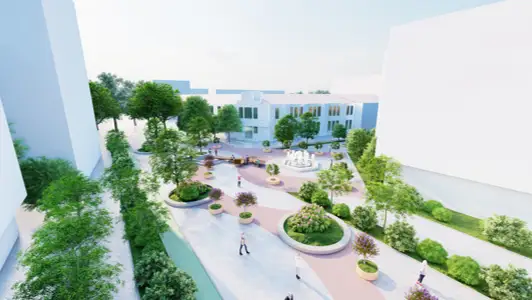
Pedestrian Zone Extension in Central Campina
Urban regeneration project for the expansion of the pedestrian zone in the central area of Campina, with emphasis on universal accessibility and smart urban furniture.
Year
2021
Location
Campina Municipality, Prahova County
Area
12,500 sqm
Category
Urban Regeneration
Urban Context and Strategic Objectives
Campina Municipality faces a challenge common to mid-sized Romanian cities: the central area, originally designed with a predominantly automotive traffic paradigm, no longer adequately serves the evolving needs of the community. Increasing pedestrian flows, growing demand for recreational spaces, and the imperative to reduce carbon emissions have prompted the local administration to initiate an ambitious urban regeneration project.
The primary objective of this intervention was the transformation of over 12,500 sqm of urban space into a modern, accessible, and sustainable pedestrian zone. The project pursued the integration of universal design principles, ensuring unimpeded access for all user categories, including persons with reduced mobility.
The technical documentation was prepared in compliance with national spatial planning and urbanism legislation, while also adhering to European directives on sustainable urban mobility.
Design Solutions and Urban Intervention
The design team proposed an integrated approach, combining classical landscape architecture elements with modern smart infrastructure solutions. The principal interventions included: complete conversion of roadway surfaces into pedestrian spaces with permeable paving, installation of an LED public lighting system with motion sensors, and implementation of modular urban furniture.
The pedestrian space was configured across three distinct functional zones: the main promenade zone with an 8-metre width, the recreational activity zone with facilities for children and seniors, and the adjacent commercial zone, designed to support the economic activity of central area retail establishments.
Particular emphasis was placed on stormwater management through green infrastructure solutions, including rain gardens and ecological swales integrated into the landscape design.
SMART Components and Digital Infrastructure
The project incorporated a significant public space digitalisation component. The integrated monitoring system enables real-time measurement of pedestrian flows, air quality, and ambient noise levels.
Public Wi-Fi infrastructure, deployed through 12 access points uniformly distributed across the pedestrian perimeter, provides complimentary connectivity for citizens and visitors. Data collected via IoT sensors is transmitted to the municipal urban management platform, facilitating informed decisions regarding space maintenance and optimisation.
Additionally, 6 charging stations for electric bicycles and scooters were installed, connected to the city's renewable energy network.
Outcomes and Community Impact
The project's completion has generated measurable positive impact on the quality of urban life in Campina. Pedestrian traffic in the central zone increased by approximately 40% within the first six months of inauguration, while commercial activity in adjacent retail establishments recorded an average growth of 25%.
The project was financed through the Regional Operational Programme 2014-2020, Priority Axis 4 -- Supporting Sustainable Urban Development, with a European non-reimbursable funding contribution of 85% of the total eligible value.
Gallery
Discover how our Urban Regeneration services made this project possible
This project demonstrates our team's expertise in delivering integrated solutions. Explore the full range of services or discuss a similar project with our team.